
Abuse is 24/7. Help Isn't
Where do you go for help when you can't leave, can't make a call, or you think you are losing your mind? Or maybe you are worried for someone else.


Aimee Says may be relevant to you or someone you are concerned about in an abusive relationship. Not everyone who is abused is aware of their situation, and to leave abuse, you need a plan and support. The first three months after leaving are known to be the most dangerous, and to increase your safety, you need to let as many people as possible know you are at risk.
The sense of shame, combined with the abuser's assurances that nobody cares, keeps the abused person silent, thus empowering the abuser even more. Domestic violence causes the person to live in physical and psychological fear. The idea of leaving can be so terrifying (rightfully so) that they believe staying is safer, and even when they do leave, they are known to return again and again.
Much to the dismay of friends and family, sometimes returning feels like the safest option.
Frustratingly, there is a severe lack of funding and access to support for victims of abuse. It takes enormous courage to call a helpline, and when they do, they shouldn’t have to wait long to speak to someone. This isn't the case. In the US, the wait time of forty-five minutes or longer isn’t uncommon, by which point that person has had to hang up, and possibly won’t call again. Another issue I was recently made aware of is that not every organisation can help with the specific needs of the caller, forcing them to start the process all over again.
People in abusive relationships should not have to jump through hoops to get the help they need.
Safety First Before Opening Aimee Says
Before you open Aimee Says, be sure you are safe to do so. It's possible your abuser is monitoring your calls, your internet usage, and possibly your movements. If you are still living in the home, and you believe you are safe, it is best to open Aimee Says in a private or incognito browser only. Before you sign up, create a new email address that is only known to you and don't save the password on any device. There is a quick exit button at the top right of the screen, should you need to close the chat quickly.
Remember, your physical safety must come first.
If you have already left the home and are sure you are physically safe, this advice is still relevant to you, especially when you have children with whom you share accounts, passwords, and the home wi-fi.
Are you living with your abuser?
How are you accessing support? Who knows you are in an abusive relationship? Or are you uncertain about what you are experiencing? Getting access to help when you need it the most can feel like an impossible ask, and that is why Anne Wintemute created Aimee Says. She wanted to fill the gap (gaping hole) between getting professional help and the actual, realistic availability at the time you need that help.
Aimee Says is designed to help people in domestic violence situations, using non-escalatory language, and available 24/7 across the globe. Whilst people turn to AI platforms to ask questions about their situation, these models are not trained in the domestic violence space to give you the necessary guidance. It is also possible that your data will be used to train their models. Aimee does not see your chat data, and doesn't use your chats to train Aimee Says.
For this article, Domestic Violence encompasses all forms of domestic abuse — coercive control, financial abuse, and physical and psychological harm.
How I used Aimee Says
Aimee Says can be used on your desktop or downloaded as an app. I tried both. I also tried the free and paid option (7-day free trial) to see what the differences were and how the paid option would benefit me.
When you start, there is an option to choose your scenario. I chose 'I am here for someone else,' and typed in my concern of witnessing a friend in an unsettling dinner party confrontation with her spouse. I shared it all in the chat. Aimee didn't shout, 'This is abuse.' Instead, it suggested ways to reach out to my friend and the type of language I should use when broaching the subject with her. Aimee didn't point fingers, but recommended showing my friend I am there for her.
A small gesture from you can make all the difference to someone living with domestic violence.
Then I had a chat with Aimee as though I was losing my mind and wasn't sure if my spouse was being overly caring or overbearing and controlling. Aimee asked questions about my observations, my feelings, and when I said I wanted help, suggested organisations relevant to where I live.
These organisations are sourced from the Internet and are not recommendations.
The Free vs the Paid Version
I started in the free chat, where every time you close the chat, your conversation is not saved. The support quality remains the same, no matter which version you use.
Anne recommends checking out the free version at first to see if it works for you.
I then signed up for the paid version, and if you can afford it, I highly recommend you do. The level of organisation it provides is hard to overstate. It is known that divorce is overwhelming, but leaving domestic violence is considerably harder. Anne has created a space within Aimee Says to upload your essential documents, paperwork needed for your legal team, your therapist, child protective services, family courts, and whatever else you may need. All you have to do is add it to a folder and label it, and if that feels like too much, Aimee can search for the document you need if you haven't labelled it or filed it correctly.
To be this organised with instant access to essential paperwork at a moment's notice is a blessing. Not only are your papers stored in one place, but you can send, upload, and have Aimee flag information you would otherwise forget or possibly not know you need.
Binders are there to organise everything relevant by category. You can search within a Binder and ask Aimee to analyse the documentation saved. If that's not enough, you can add a ’team member’ to collaborate with. I recall an interview where a woman had hundreds of pages of documents for her divorce that spanned five years. Trying to find something at a moment's notice was an impossible task, especially as time passed and the exhaustion set in. The amount of time this tool can save you is remarkable.
Why documenting abuse is vital.
If you haven't experienced abuse or haven't gone through a divorce, you are probably unaware of the planning and time it takes. Leaving abuse physically does not mean the abuse ends. It's known that the abuse can escalate in the first few months after leaving. Someone in a high-conflict divorce can also experience abuse where one person can use intimidation, financial pressure, and endless demands to wear the other person down. When up against an ex whose goal is to harm you, documenting everything systematically and having a tool to help you find information when there are numerous pages may help you maintain some level of sanity and control.
'Domestic Violence - when one person is being dominated by another person.'
Post-Divorce Abuse
Divorce in all its complexities and initial intent to be amicable doesn't always play out that way. Some abuse starts after you have left, usually when it comes to the children and finances.
The number of people who have shared stories with me about their ex spamming them with emails and messages demanding an immediate response, or changing the time of pick up without notice, or cancelling altogether at the last minute is unacceptable, but not uncommon. At first, you may be frustrated with this annoying behaviour, but over time, it becomes abuse. It's normal to respond quickly when it involves the children, only to realise you have reacted rather than responded to the actual demand. This technique of abuse can potentially cause you harm in the family court, where your responses and reactions will be presented as abuse and used against you for custody.
Protecting your children can genuinely backfire when your emotions are aired on paper.
Try uploading the correspondence and ask Aimee to help you draft a non-emotional, non-reactive response. Should you need to go to court, you can share the history of this communication and what you have had to put up with. Judges make decisions based on the information they are presented with.
Aimee's responses are non-reactive, measured, and won't engage in their game of pulling you in.
Document Everything as it happens.
By tracking all your conversations and abusive events, Aimee can show you an infographic using all your shared data. You get to witness the patterns, the number of events, and the type of abuse. This is your story. You may have been so conditioned by the abuse you experienced that you dismissed certain behaviours at first, only to realise them after you left.
Aimee helps organise communication and events more neutrally, reducing emotionally reactive responses that could later be used against you.
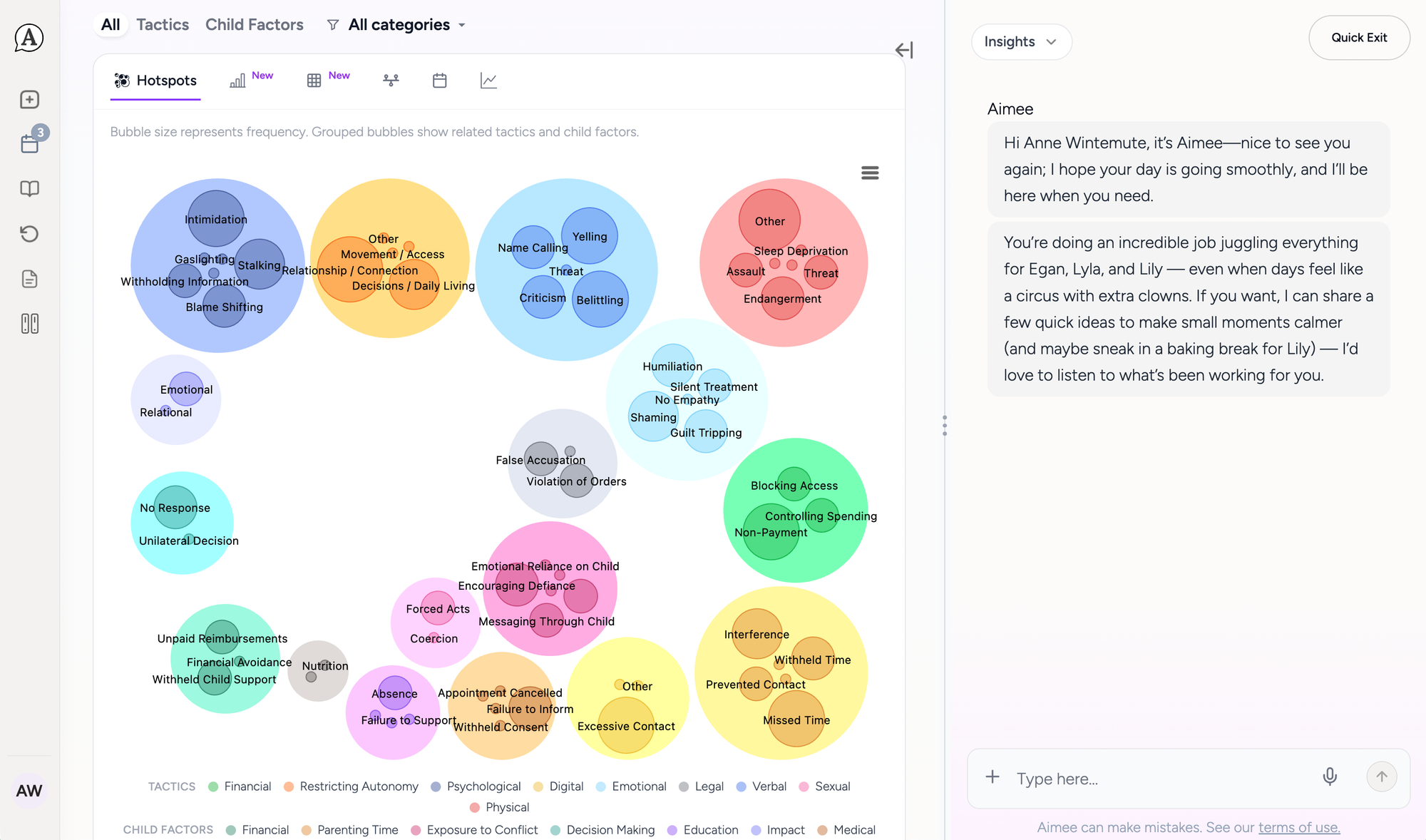
It's important to understand how your responses and reactions are perceived by someone who doesn't know you or what you are experiencing.
Awareness and Healing
Another tool Aimee offers is perspective. Try using the history of your chats to see how you have evolved and how you used to react to your abuser. You can ask Aimee to suggest coping techniques by defining what healing and moving forward mean to you. It may be something small, such as leaving your phone on silent or not responding to a call immediately. Aimee can suggest ways to help you make this achievable.
Aimee Says is not there to replace professional help.
Do you need to be in an 'overtly' abusive relationship to use Aimee Says?
I think you can just be going through a divorce to utilise everything Aimee Says has to offer. Divorce can feel isolating, scary, and, with family and community dynamics, can also bring shame. Often, the person you were married to behaves in ways you never thought possible. Perhaps you are struggling with managing the paperwork, preparing for court, or working out co-parenting, and need suggestions. Your ex might not be paying child support, or maybe they had an affair, and you are still processing your emotions. You may need information about hiring a lawyer and what questions to ask. Aimee can also be that safe space to offload your fears in the silent moments when the children are asleep.
What Aimee Says Is Not
This is not a replacement for therapy, legal advice, or trained domestic violence advocacy. This is a way to bridge the gap between reaching out for help and getting access to it 24/7.
There are people out there who want to get you the help you need. People who have been where you are, and are trained in how to support you. You may have been told you are alone. It's a lie, you are not.
Further reading
- Paranoia or Reality? What Do You Do When You Suspect Your Spouse Is Bugging You or Stalking You?
- I Never Realised I Was in Danger Until She Asked If I Was OK
- Abuse Can Catch You By Surprise
Whilst the laws around the world are shifting regarding abuse and access to your life and online searches, I recommend you check your legal rights accordingly. In a moment of pain and frustration you may search something, email a friend, or even a text message that can be used against you.
If you have experienced or left an abusive relationship and want to share your story, I would like to hear it. Contact me here.